

Solar Thermal
Heat from the sun for hot water, Heating/ventilation and industrial uses, with a study that "fits" the actual consumption profile and reduces fuel and electricity.
Hot water • Heating • Industrial Heating • Thermophotovoltaics (PV/T)Solar thermal energy is the "quiet" superpower of the energy transition: it converts solar radiation directly into useful heat (water or air), exactly where it is consumed. And in Greece, there is a special reason to trust it: for decades, the Greek solar water heater industry has been a global benchmark, not as a fashion, but as an everyday practice that filled rooftops, islands, and cities with proven savings. This “DNA” of experience is invaluable today, because the need for cheap, clean heat is greater than ever.
What we achieve with a well-designed solution
- - Reduction of fuel costs (oil, LPG, natural gas, biomass) for the production of domestic hot water and/or heat.
- - Reduction of electricity consumption in systems where heat is produced electrically (electric resistance heaters, heat pumps).
- - Stabilization of energy costs and protection against price volatility.
- - Additional performance/efficiency “lever” when combined with photovoltaic systems and smart load management.
Where it suits best
- - Residential buildings (domestic hot water, space-heating assistance, swimming pools).
- - Hotels / accommodation facilities (high and steady domestic hot water demand).
- - Workshops & industrial facilities (preheating, low- and medium-temperature processes).
- - Livestock and agricultural units (hot water, ventilation, drying).
- - Sports centers, hospitals, nursing homes, and other facilities with continuous thermal loads.

How does the Solar Thermal Energy work
In contrast to electricity generation, solar thermal technology ‘takes a shortcut’: it absorbs solar radiation and converts it directly into heat with very high efficiency. In practice, a collector heats a fluid (water or a water/glycol mixture) or preheats air. The heat is stored in a tank (boiler/storage tank) or used directly (e.g. preheating ventilation air).
Flat-plate, evacuated-tube, air (solar air heater), or concentrating (for higher-temperature applications).
Domestic hot water (DHW) tank, heating buffer tank, or process storage tank. Storage is the “secret” to stability.
Circulation pumps, sensors, antifreeze protection, weather compensation, and control logic that prevents stagnation and overheating.
The main types of systems
- * Water Heater Systems (classic, simple, very widespread): circulation is by natural flow.
- * Forced circulation (with controller): better flexibility, larger installations, larger tanks.
- * Drainback (self-draining): reduces risks of frost/stagnation where hydraulically suitable.
- * Solar air preheating for ventilation/heating (ideal in industrial and agricultural buildings).
- * Concentrated solar thermal for medium/high temperature heat production (special industrial applications).

Developments and modern applications
Solar thermal has evolved far beyond the “simple” water heater. Today we see:
- * Better selective coatings and thermal insulation that increase efficiency and reduce losses.
- * Large-scale systems for hotels, industries and facilities with continuous consumption.
- * Solar district heating and large thermal fields with storage tanks.
- * Solar thermal for industrial heat: process water preheating, washing, pasteurization, CIP, drying.
- * Connection to heat pumps: the sun preheats the circuit and the heat pump “steps up” when needed.
A large part of the final energy consumption in buildings and industry is heat. Solar thermal responds directly to this, with low complexity and long lifespan.
Savings in housing
At home, the most efficient application is domestic hot water (DHW). In this case, solar thermal systems can cover a significant part of the annual needs, especially in areas with high sunshine. When the house also has heating needs, solar thermal can operate in an auxiliary role (with appropriate emitters and hydraulics), reducing boiler operation or the electrical consumption of a heat pump.
What we evaluate to ensure economic viability
- - Daily/seasonal DHW and heat consumption profile.
- - Available surface, orientation, slope, shading, wind/salinity (coastal areas).
- - Collector type and desired temperatures.
- - Storage volume and strategy (how many hours/days of autonomy).
- - Backup (boiler/heat pump/electric resistance) and automation.
Energy savings in commercial buildings and production
Where solar thermal truly becomes a “champion” is in buildings with constant and increased heat demand. Examples:
Hotels & tourism
DHW in hotels (showers, kitchens, laundry rooms, swimming pools/spas) has high consumption, especially during periods of high sunshine. This makes solar thermal ideal: it “works” when you need it most, drastically reducing oil/LPG/electricity.
Factories, crafts, laundries, food & beverages
Many processes require hot water or low/medium temperature heat: washing, preheating, cleaning, product preparation, drying. Solar energy can act as preheating which reduces boiler loading, improving overall production costs.
Livestock units & agricultural applications
In livestock and agricultural facilities, heat is not a luxury: it is hygiene, productivity and quality. Hot water for washing/disinfection, preheating of ventilation air, heating of spaces where required, and drying applications. Solar thermal energy in the air (solar air heaters) can dramatically reduce the cost of ventilation/heating in large buildings.

The added benefit of thermal photovoltaics (PV/T)
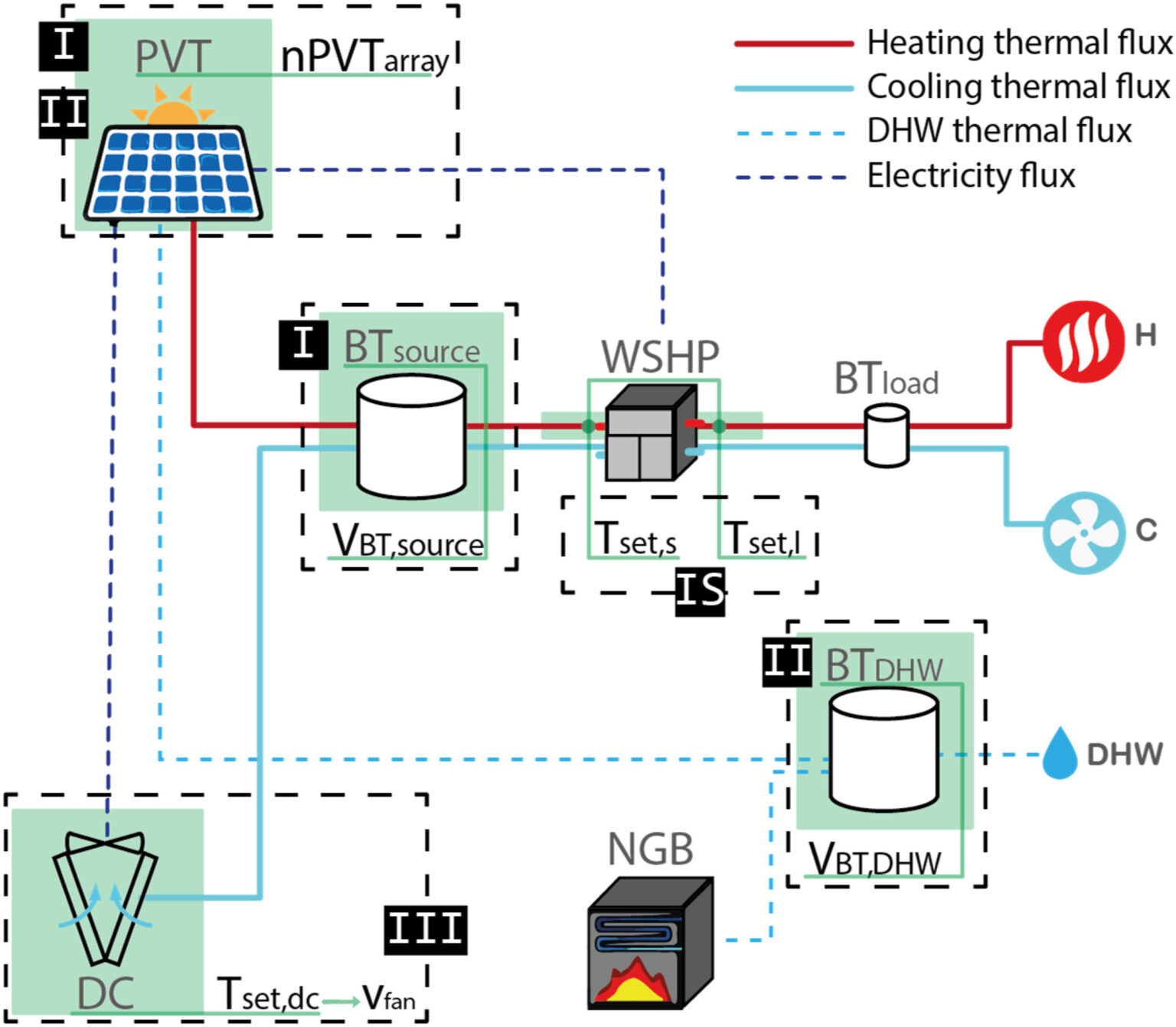
Thermal photovoltaics (PV/T) combine electricity generation and heat generation from the same surface. The idea is simple: a photovoltaic panel converts part of the radiation into electricity, but a large part “leaks” as heat. In PV/T, this heat is collected (with water or air) and utilized, while cooling the photovoltaic surface helps the electrical efficiency to remain better at high temperatures.
Where they offer practical advantages
- * Limited space: when the roof/facade does not “fit” both the thermal and photovoltaic field.
- * Parallel need for electricity and heat (DHW, preheating, heat pump support).
- * Heat pump systems: PV/T can provide a “source” of heat or preheating, reducing consumption.
- * Ventilation/air conditioning in large buildings: PV/T air can preheat fresh air and save fuel.
How to combine solar thermal and photovoltaics in practice
The real value is not to “put both”, but to combine them correctly:
- * Energy mapping: hourly/daily profile of heat and electricity loads.
- * Heat targeting: DHW, processes, preheating, heating support — where efficiency/economy is maximum.
- * Electricity targeting: self-consumption, smart load management, storage where needed.
- * Integrated automation: priorities, thermal storage, pump control/compensation, waste avoidance.
- * Mechanical/hydraulic quality: correct cross-sections, hydraulic balancing, anti-freeze/anti-corrosion protection, maintainability.
In facilities with constant heat demand (e.g. hotels, laundries, crafts, livestock) the combination of solar thermal + photovoltaics often leads to a short payback period of 3–6 years, when the study is based on real consumption data and the appropriate mix of technologies/storage.
In addition, we can structure financing solutions (e.g. installments/equipment financing, energy service, contracts with a fixed price per kWh of heat/electricity where applicable), so that the project is paid for by the savings itself.
Quality, documentation and reliability
In energy technology, performance is necessary but not sufficient. The market (and especially professional applications) demands documentation, certifications, measurability and transparency. At the European policy level, frameworks have been developed for evaluating “green” technologies and verifying claims by third parties, so that investments are based on real data rather than promises.
Our approach
- * Study based on data (consumption, temperatures, operating hours, actual fuel/invoices).
- * Design for maintenance (easy access, spares, avoidance of "hidden" failures).
- * Measurements & monitoring where required (heat metering, production, savings KPI).
- * Realistic business case: price scenarios, seasonality, storage, financing.
Frequently asked questions (FAQ)
Does solar thermal energy work in winter?
Yes. Production is lower than in summer (less radiation and greater losses), but it remains useful, especially when there is adequate storage capacity and the right temperature strategy.
Which is more important: the collector or the storage?
Both. However, storage and automation are often the "hidden" factors that make a system perform consistently and not waste energy.
Can it be combined with a heat pump?
Yes, and it is often a very efficient combination. Solar thermal energy and/or PV/T can preheat the circuit, reducing the work of the heat pump and its electricity consumption.
What do I need to get a quotation?
Ideally: (a) recent electricity and fuel bills, (b) a brief description of heat uses (DHW/washing/processes), (c) photos/drawing of the roof or available surface area, (d) operating hours and seasonality.
Contact us for a targeted pre-assessment: savings estimate, proposed architecture, and implementation plan with realistic payback period.